
Barcelona, Looking at the Walls
A few weeks in Barcelona for a beautiful faux-wood project on a private boat. The client prefers to remain discreet, so there are no images of the project.
Outside the worksite, I walked. And naturally, because of my profession, I tend to look at cities a little differently: the walls, the materials, the ceilings, the patinas, the details you do not always notice at first glance.

A Detour via Miró
A few decades later, Miró carries on this very Barcelonian sense of freedom in his own way: simple forms, strong colour, and an ability to create something almost childlike yet instantly recognisable.

A Garden on the Ceiling
At Casa Vicens, I find exactly what I love: when technique disappears behind the effect. Palm leaves, painted sky, trompe-l’œil… the garden seems to enter the house.

The Art of Sgraffito
Sgraffito is everywhere in Modernista Barcelona. Yet the technique is much older: inherited in particular from the Italian Renaissance, it consists of layering different coloured plasters, then scratching through the upper layers to reveal the design beneath. In Barcelona, Modernista architects embraced it with extraordinary freedom.

Even the Furniture Tells the Story
At Casa Amatller, Teresa’s bedroom is a little jewel. Bright, colourful and overlooking Passeig de Gràcia, it shows just how carefully decoration was considered, right down to the furniture.

Under the Sea
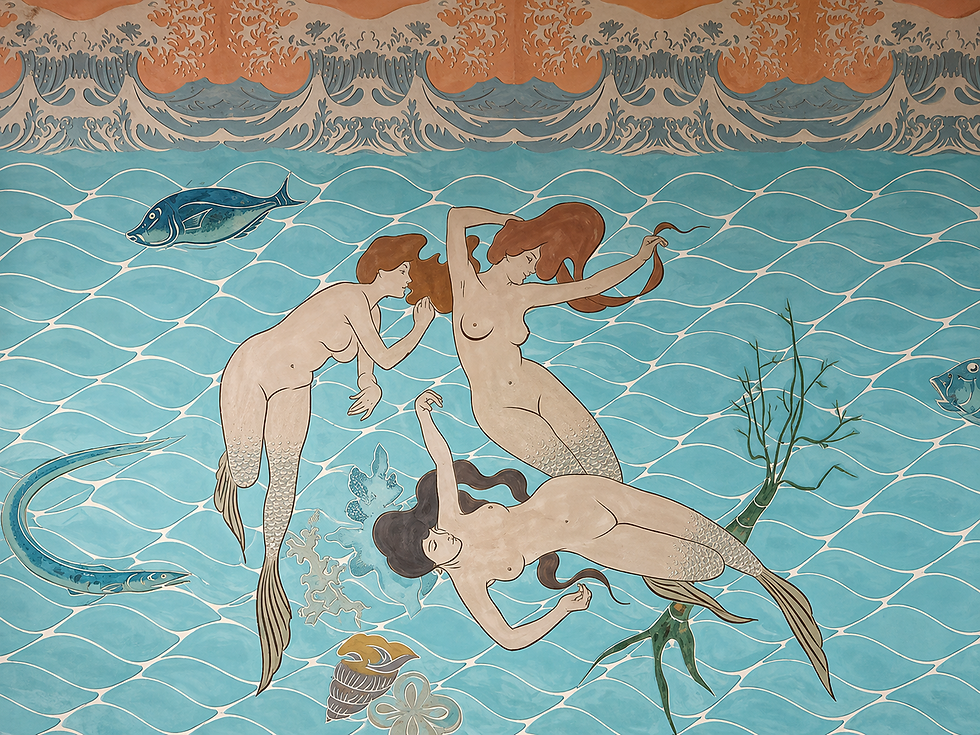
At Hotel España, the atmosphere changes completely. Mermaids, fish and waves plunge us into an underwater landscape. Once again, the wall is never simply a wall.
Material, According to Gaudí
At Casa Batlló, I stopped to look closely at this beautifully executed stucco. Incised lines, subtle tonal variations and touches of gold turn the wall itself into something almost precious. And once again, the sea seems to be present in the movement of the forms.

And Always, the Mediterranean
After spending so much time looking at walls, ceilings and decorative details, it is time to step outside again. Palm trees, light, and in the distance, the contemporary silhouette of W Barcelona.

What I like about this walk is the way Barcelona tells the story of decoration so naturally. At the end of the 19th century, Catalan Modernisme brought architects, painters, ceramicists, sculptors and craftsmen together.
Perhaps that is what still gives the city its particular character today: decoration is not something added to the architecture afterwards. It is part of the architecture itself.
And when you work with materials yourself, you never quite look at walls in the same way again.


Comments